The Book a History of the Bible Book Review
A Book Review from Books At a Glance
Past Andrew Ballitch
Summary and Review
In this massive, just readable volume, John Barton offers an exhaustive history of the Bible, from an introduction to the literature of both testaments, to how the Bible came to be and how it has been interpreted over the centuries. He hopes his book volition outset, dispel the notion of the Bible as a sacred monolith, second, illustrate the difficulty of moving from the Bible to organized religion, and, finally, showcase the Bible equally an important source of religious insight. His thesis: "The Bible does non 'map' straight on to religious faith and practice, whether Jewish or Christian." The Bible is irreplaceable, only "Christianity is non in essence a scriptural religion, focused on a volume seen as a single, holy work" (ii). In short, when the Bible is viewed as Holy Scripture, as inspired by God with all of inspirations entailments, it denies the depth, diversity, and richness of the texts.
In part 1, readers are introduced to the history of aboriginal State of israel and the Hebrew genres of narrative, constabulary, wisdom, prophecy, and poetry. The discussions of genre and considerations for interpretation are insightful, but the presentation every bit a whole feels like an practise in 'null is as information technology seems.' This what-you-probably-assumed-is-wrong arroyo continues in function 2, where he, once more, puts forward the consensus conclusions of historical criticism, this time of the New Testament. Barton argues that no neat relationship exists between the One-time and New Testaments, pits Paul against orthodoxy on the resurrection and divinity of Jesus, and buys into the New Perspective on Paul, deflating the importance of justification by religion.
In part iii, the book transitions to being more reliably informative and helpful, though not in its conclusions and recommendations. Here Barton explores canonization and manuscripts. On the one-time, he makes the helpful distinction in the procedure of going from a list of books that are "at least" Scripture, to a list that are "at about" Scripture (223). While the formal process of canonization of the New Attestation was not finalized until the quaternary century Ad, he recognizes that the New Attestation books were considered Scripture in the 2d. This discounts the popular nonsense that authorities in the church made capricious or worse, self-serving, decisions virtually what books were in and which ones were out. In the chapter on manuscripts, he greatly undersells the reliability of the Greek New Testament every bit we have it today, asserting that no appeal to the exact wording of the text is even possible.
Apart from the argument that any overarching theme of the Bible is necessarily superimposed, part four, which handles the history of biblical interpretation and translation, is on point. Barton's comparison and contrast of Rabbinic and early church interpretation is enlightening. His tracing of the developments in biblical interpretation through the Middle Ages and Reformation is authentic and calls attention to all of the main players. He correctly identifies the Enlightenment every bit the true watershed in hermeneutics, when meaning was unhinged from truth, history divorced from religion. The concordat between criticism and religion that existed from the middle of the nineteenth century through the years later World War 2 is identified, likewise equally the increasing hostility between critical claims and religion in the concluding few decades, the exception to this development being, of form, the canonical approach and its offshoots, including the Theological Interpretation of Scripture.
In his conclusion, entitled, "The Bible and Organized religion," Barton drives domicile his thesis. He claims that the Trinity, divinity of Christ, and fifty-fifty monotheism do non spring from the Bible alone. Basically, no reading of the Bible could predict what the church ended upwards believing or looking like. After identifying what he believes are three unexplainable paradoxes that result from alternatives to his conclusions, namely, the acceptance of the Old and New Testaments together, inspiration and human authorship, and the strained readings that stem from an authoritative text, he offers a metaphor for his position. The Bible and faith are like two concentric circles that overlap but are not coterminous. Confidently included in the contents of the overlap are "absolute allegiance to Jesus Christ, and the conventionalities that 'God was in Christ'" (488). Anything more than that is adiaphora.
Critique
Where to brainstorm? Well, I would similar to begin by stating two things almost this book that I greatly appreciate. 1 is the incredible breadth of familiarity that Barton demonstrates with Christianity and Judaism as they exist today and have existed over the course of millennia, added to a command of the Bible and the history of its handling and interpretation. It is quite credible that this book is the event of a long, thoughtful, and fruitful career. Two, Barton is upwards front almost his own theological convictions. He is a theological liberal, bought into historical criticism with its conclusions, and, honorably, he owns that. The concerns I have come every bit a historian, theologian, and pastor.
While Barton does reference primary sources and their authors throughout the book, he does not cite them in such a manner that they are the principal bear witness for his argument. Take, for example, his affiliate on Reformation interpretation. The endnotes brandish substantive interaction with the international secondary literature, but little primary source piece of work, which, when information technology does appear, is non tied to first or best editions. On a separate historical note, every bit an Anglican, Barton finds inspiration for his treatment of the Bible from Richard Hooker's 1594 treatise, Of the Laws of Ecclesiastical Polity: we must take heed lest "in attributing unto Scripture more than it can have, the incredibility of that do cause even those things which indeed it hath most abundantly, to exist less reverently esteemed" (13, 489). Huh? As the title of the work hints, this treatise was written in the context of the sixteenth-century Puritan push button for farther Reformation in the polity and liturgy of the Church building of England. Hooker may not have seen the Bible and faith as coterminous concentric circles, but the content of the overlap, "those things which indeed (Scripture) hath well-nigh abundantly," included staggeringly more in his estimation than allegiance to Jesus equally the self-expression of God. It included the Trinity, the divinity of Christ, and, yes, the doctrine of verbal plenary inspiration.
The theological problems, from a confessional Christian signal of view, are many. I have already mentioned Barton'south deprival of central orthodox tenants of the faith, or at the very least his relegation of them to marginalia. One more illustration of the bias of naturalistic presuppositions is his treatment of the Old Attestation prophets. Because true predictive prophecy is precluded, the major and minor prophetical books are hopelessly sliced to pieces with source critical knives. Of course Daniel was written in the second century BC, it is the only option if predictive prophecy is impossible. Plus, those who encounter prophecy fulfilled in the New Testament or the time to come necessarily read the text as cryptic in the absence of a category for legitimate typology.
To be fair, Barton is non hostile toward "Fundamentalism," his designation which includes evangelicals who concord to inspiration. Merely he is dismissive. He raises questions that he considers unanswerable and then moves on without considering those answers that take been offered. Examples include his treatment of inspiration, of course, only also the Ten Commandments as impossible to understand as a universally bounden moral code of ethics. On the very concluding page of his conclusion he challenges readers to inquire whether what he has offered is plausible and fruitful. Plausible, yes. Fruitful? That question brings to mind a historical axiom, incontrovertibly proven over the last two-hundred years. That is, liberalism does non make converts, it steals them. No one will be drawn to the gospel by reading this book. Movement, if it happens, will exist the other direction.
As a historian I cannot recommend this book equally methodologically compelling. As a theologian I cannot recommend it as doctrinally sound. And, as a pastor, neither can I recommend it as rubber. At ane bespeak, those who translate the Bible with the church (aka equally Holy Scripture) are charged with "inhabiting the world of Origen and Augustine, not that of the modern historical critic" (481). Indeed, and Moses, Isaiah, Jesus, and Paul. Gladly!
Reviewer Bio
Andrew S. Ballitch (PhD, Southern Baptist Theological Seminary) is a pastor at Westwood Alliance Church in Mansfield, Ohio.
Buy the books
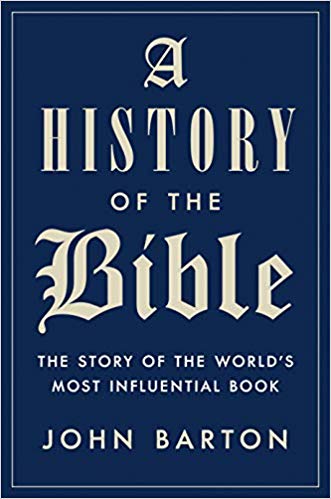
A HISTORY OF THE BIBLE: THE STORY OF THE Globe'S MOST INFLUENTIAL BOOK, past John Barton
From: Amazon ( Kindle )
From: Amazon ( Audiobook )
From: Amazon ( Hardcover )
From: Amazon ( Paperback )
Source: https://www.booksataglance.com/book-reviews/andrew-ballitchs-review-of-a-history-of-the-bible-the-story-of-the-worlds-most-influential-book-by-john-barton/

Post a Comment for "The Book a History of the Bible Book Review"