Cat Nrr40 Reading 0 Battery When Battery Is Fully Charged
Explore SoC measurements and why they are not accurate.
Voltage Method
Measuring country-of-charge by voltage is uncomplicated, only it can be inaccurate because prison cell materials and temperature affect the voltage. The most breathy error of the voltage-based SoC occurs when agonizing a battery with a charge or discharge. The resulting agitation distorts the voltage and it no longer represents a correct SoC reference. To get accurate readings, the battery needs to residuum in the open excursion state for at least iv hours; bombardment manufacturers recommend 24 hours for lead acid. This makes the voltage-based SoC method impractical for a bombardment in agile duty.
Each battery chemistry delivers its ain unique discharge signature. While voltage-based SoC works reasonably well for a lead acid battery that has rested, the flat discharge curve of nickel- and lithium-based batteries renders the voltage method impracticable.
The discharge voltage curves of Li-manganese, Li-phosphate and NMC are very flat, and eighty percent of the stored energy remains in the flat voltage profile. While this characteristic is desirable as an energy source, it presents a claiming for voltage-based fuel gauging as it only indicates full accuse and low charge; the important middle section cannot be estimated accurately. Figure ane reveals the flat voltage profile of Li-phosphate (LiFePO) batteries.
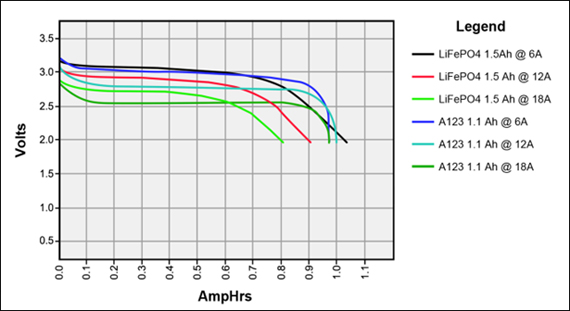
Li-phosphate has a very flat discharge profile, making voltage estimations for SoC estimation difficult.
Lead acid comes with different plate compositions that must be considered when measuring SoC by voltage. Calcium, an additive that makes the bombardment maintenance-free, raises the voltage by 5–8 percent. In addition, heat raises the voltage while common cold causes a decrease. Surface charge further fools SoC estimations past showing an elevated voltage immediately afterward charge; a brief discharge earlier measurement counteracts the error. Finally, AGM batteries produce a slightly college voltage than the flooded equivalent.
When measuring SoC by open up circuit voltage (OCV), the battery voltage must exist "floating" with no load attached. This is not the case with modern vehicles. Parasitic loads for housekeeping functions puts the battery into a quasi-closed circuit voltage (CCV) condition.
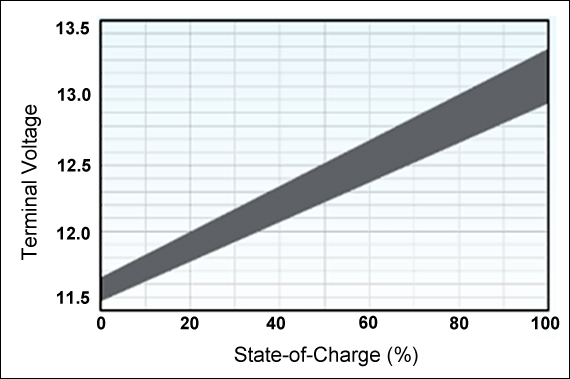
In spite of inaccuracies, most SoC measurements rely in office or completely on voltage because of simplicity. Voltage-based SoC is pop in wheelchairs, scooters and golf cars. Some innovative BMS (battery management systems) utilise the residuum periods to adjust the SoC readings as part of a "acquire" office. Figure two illustrates the voltage band of a 12V lead acid monoblock from fully discharged to full charged.
Hydrometer
The hydrometer offers an alternative to measuring SoC of flooded lead acid batteries. Here is how it works: When the pb acrid battery accepts charge, the sulfuric acid gets heavier, causing the specific gravity (SG) to increment. As the SoC decreases through discharge, the sulfuric acid removes itself from the electrolyte and binds to the plate, forming lead sulfate. The density of the electrolyte becomes lighter and more than water-like, and the specific gravity gets lower. Table 3 provides the BCI readings of starter batteries
| Approximate state-of-charge | Boilerplate specific gravity | Open circuit voltage | |||
| 2V | 6V | 8V | 12V | ||
| 100% | 1.265 | two.10 | 6.32 | 8.43 | 12.65 |
| 75% | ane.225 | 2.08 | six.22 | 8.30 | 12.45 |
| 50% | 1.190 | two.04 | vi.12 | viii.xvi | 12.24 |
| 25% | i.155 | 2.01 | vi.03 | eight.04 | 12.06 |
| 0% | i.120 | 1.98 | 5.95 | vii.72 | xi.89 |
Readings are taken at 26°C (78°F) after a 24h residue.
While BCI (Battery Council International) specifies the specific gravity of a fully charged starter battery at i.265, bombardment manufacturers may become for 1.280 and college. Increasing the specific gravity will move the SoC readings upwards on the await-up tabular array. A higher SG will improve bombardment performance but shorten bombardment life because of increased corrosion activity.
Besides charge level and acrid density, a low fluid level volition as well change the SG. When water evaporates, the SG reading rises because of higher concentration. The battery can also be overfilled, which lowers the number. When adding water, allow time for mixing before taking the SG measurement.
Specific gravity varies with battery applications. Deep-cycle batteries apply a dumbo electrolyte with an SG of upwards to i.330 to get maximum specific free energy; aviation batteries take an SG of about i.285; traction batteries for forklifts are typically at 1.280; starter batteries come in at 1.265; and stationary batteries have a depression specific gravity of one.225. This reduces corrosion and prolongs life but it decreases the specific free energy, or capacity.
Nothing in the battery globe is accented. The specific gravity of fully charged deep-cycle batteries of the same model can range from 1.270 to 1.305; fully discharged, these batteries may vary betwixt 1.097 and 1.201. Temperature is another variable that alters the specific gravity reading. The colder the temperature drops, the higher (more than dumbo) the SG value becomes. Tabular array four illustrates the SG gravity of a deep-cycle battery at diverse temperatures.
| Electrolyte temperature | Gravity at full charge | |
| twoscore°C | 104°F | 1.266 |
| 30°C | 86°F | 1.273 |
| twenty°C | 68°F | one.280 |
| 10°C | 50°F | ane.287 |
| 0°C | 32°F | one.294 |
Colder temperatures provide college specific gravity readings.
Inaccuracies in SG readings can besides occur if the battery has stratified, pregnant the concentration is low-cal on peak and heavy on the lesser(See BU-804c: Water Loss, Acid Stratification and Surface Charge) High acid concentration artificially raises the open circuit voltage, which tin fool SoC estimations through false SG and voltage indication. The electrolyte needs to stabilize after charge and belch before taking the SG reading.
Coulomb Counting
Laptops, medical equipment and other professional portable devices use coulomb counting to gauge SoC past measuring the in-and-out-flowing current. Ampere-second (Equally) is used for both accuse and belch. The name "coulomb" was given in honor of Charles-Augustin de Coulomb (1736–1806) who is best known for developing Coulomb's police force(Meet BU-601: How does a Smart Battery Piece of work?)
While this is an elegant solution to a challenging result, losses reduce the total energy delivered, and what's available at the end is always less than what had been put in. In spite of this, coulomb counting works well, especially with Li-ion that offer high coulombinc efficiency and low cocky-discharge. Improvements have been made by likewise taking aging and temperature-based self-discharge into consideration but periodic calibration is notwithstanding recommended to bring the "digital battery" in harmony with the "chemic battery."(See BU-603: How to Calibrate a "Smart" Battery)
To overcome calibration, modern fuel gauges use a "learn" office that estimates how much free energy the battery delivered on the previous discharge. Some systems also observe the charge time because a faded battery charges more quickly than a skillful one.
Makers of avant-garde BMS claim loftier accuracies but real life often shows otherwise. Much of the brand-believe is hidden behind a fancy readout. Smartphones may show a 100 percent accuse when the battery is just 90 percent charged. Blueprint engineers say that the SoC readings on new EV batteries can be off by 15 percent. At that place are reported cases where EV drivers ran out of accuse with a 25 percent SoC reading notwithstanding on the fuel approximate.
Impedance Spectroscopy
Battery state-of-charge tin also exist estimated with impedance spectroscopy using the Spectro™ circuitous modeling method. This allows taking SoC readings with a steady parasitic load of 30A. Voltage polarization and surface charge do non affect the reading equally SoC is measured independently of voltage. This opens applications in automotive manufacturing where some batteries are discharged longer than others during testing and debugging and need charging before transit. Measuring SoC past impedance spectroscopy can also exist used for load leveling systems where a battery is continuously under charge and discharge.
Measuring SoC independently of voltage also supports dock arrivals and showrooms. Opening the car door applies a parasitic load of about 20A that agitates the battery and falsifies voltage-based SoC measurement. The Spectro™ method helps to identify a low-charge battery from 1 with a 18-carat defect.
SoC measurement past impedance spectroscopy is restricted to a new bombardment with a known good chapters; capacity must be nailed downwards and have a non-varying value. While SoC readings are possible with a steady load, the battery cannot be on charge during the test.
Effigy 5 demonstrates the test results of impedance spectroscopy later a parasitic load of 50A is removed from the battery. As expected, the open terminal voltage rises equally function of recovery merely the Spectro™ readings remains stable. Steady SoC results are too observed afterward removing charge during when the voltage normalizes equally part of polarization.
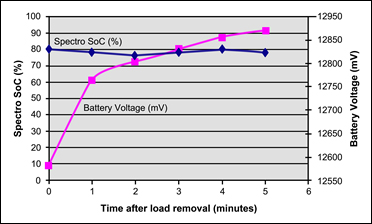
Battery is recovering later removing a load. Spectro SoC readings remain stable as the voltage rises.
References
[1] Source: Power-Sonic
Source: https://batteryuniversity.com/article/bu-903-how-to-measure-state-of-charge

Post a Comment for "Cat Nrr40 Reading 0 Battery When Battery Is Fully Charged"