Sebastian River Medical Center ~ a Steward Family Hospital Sebastian, Fl
| San Sebastián Donostia (in Basque) | |
|---|---|
| Donostia / San Sebastián | |
 | |
| Flag Coat of arms | |
| Nickname(southward): Sanse, Donosti, San Seb, La bella Easo [one] | |
| Motto(due south): Ganadas por fidelidad, Nobleza y lealtad | |
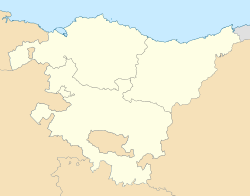
| San Sebastián Location of San Sebastián within the Basque Autonomous Community Show map of Basque Land San Sebastián San Sebastián (Spain) Show map of Kingdom of spain | |
| Coordinates: 43°19′17″N ane°59′8″Due west / 43.32139°N 1.98556°Westward / 43.32139; -1.98556 Coordinates: 43°19′17″North 1°59′viii″W / 43.32139°Due north 1.98556°Westward / 43.32139; -ane.98556 | |
| Country |  Spain Spain |
| Democratic community |  Basque Land Basque Land |
| Province |  Gipuzkoa Gipuzkoa |
| Eskualdea | Donostialdea |
| Neighbourhoods | 21 |
| Founded | 1180 |
| Government | |
| • Mayor | Eneko Goia [ii] (EAJ-PNV) |
| Area | |
| • Land | 60.89 kmii (23.51 sq mi) |
| Summit | 6 k (20 ft) |
| Population (2018)[three] | |
| • Metropolis | 186,665 |
| • Density | 3,686.16/km2 (9,547.one/sq mi) |
| • Metro | 436,500 |
| Time zone | UTC+1 (CET) |
| • Summer (DST) | UTC+2 (CEST) |
| Postal codes | 20001–20018 |
| Area code(s) | +34 943 (Gipuzkoa) |
| Website | Urban center Quango |




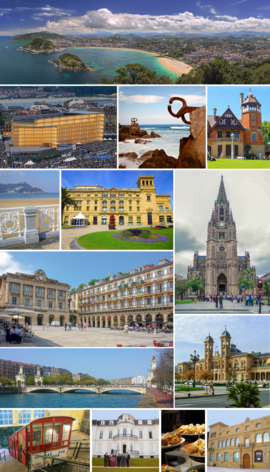
San Sebastián, besides known equally Donostia-San Sebastián (official names in both local languages: Donostia (Basque pronunciation: [doˈnos̺tia]) and San Sebastián (Spanish: [s̺an s̺eβas̺ˈtjan]))[4] is a metropolis and municipality located in the Basque Democratic Community, Spain. It lies on the coast of the Bay of Biscay, 20 km (12 miles) from the France–Spain edge. The upper-case letter city of the province of Gipuzkoa, the municipality's population is 188,240 equally of 2020,[5] with its metropolitan area reaching 436,500 in 2010.[vi] Locals call themselves donostiarra (atypical), both in Spanish[7] and Basque. It is as well a part of Basque Eurocity Bayonne-San Sebastián.
The main economic activities are almost entirely service-based, with an emphasis on commerce and tourism, as information technology has long been one of the most famous tourist destinations in Spain.[viii] Despite the city'southward small size, events such as the San Sebastián International Moving-picture show Festival and the San Sebastian Jazz Festival accept given it an international dimension. San Sebastián, along with Wrocław, Poland, was the European Upper-case letter of Civilization in 2016.[ix]
Etymology [edit]
In spite of appearance, both the Basque class Donostia and the Spanish grade San Sebastián accept the same pregnant — Saint Sebastian. The dona/washed/doni element in Basque place names signifies "saint" and is derived from Latin domine; the 2nd part of Donostia contains a shortened form of the saint's name.[10] At that place are two hypotheses regarding the evolution of the Basque proper name: one says it was *Washed Sebastiáne > Donasa(b)astiai > Donasastia > Donastia > Donostia,[11] the other one says it was *Done Sebastiane > *Done Sebastiae > *Done Sebastie > *Donesebastia > *Donasastia > *Donastia > Donostia.[12]
Geography [edit]
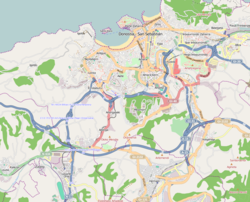
The metropolis is located in the north of the Basque State, on the south-eastern declension of the Bay of Biscay. San Sebastián has three beaches, Concha, Ondarreta, and Zurriola, and is surrounded past hilly areas: Urgull (adjacent to the former office of the city), Mount Ulia (extending east to Pasaia), Mount Adarra (south of the urban center) and Igeldo (overlooking Concha Bay from the west).
San Sebastián lies at the mouth of the Urumea river, and it was in large part built on the river'southward wetlands during the final two centuries. The urban center middle and the districts of Amara Berri and Riberas de Loiola lie on the former riverbed, which was diverted to its current canalized grade in the outset one-half of the 20th century.[13]
Climate [edit]
San Sebastián features an oceanic climate (Köppen Cfb) with warm summers and cool winters. Like many cities with this climate, San Sebastián typically experiences cloudy or clouded weather condition for the majority of the twelvemonth, typically with some atmospheric precipitation. The city averages roughly 1,650 mm (65 in) of precipitation annually, which is fairly evenly spread throughout the twelvemonth. However, the city is somewhat drier and noticeably sunnier in the summer months, experiencing on boilerplate approximately 100 mm (3.94 in) of precipitation during those months. Average temperatures range from 8.9 °C (48.0 °F) in January to 21.5 °C (70.7 °F) in Baronial.
| Climate data for San Sebastián Airport Hondarribia, (15 km (nine miles) east of San Sebastián) (1981–2010) | |||||||||||||
|---|---|---|---|---|---|---|---|---|---|---|---|---|---|
| Calendar month | January | Feb | Mar | Apr | May | Jun | Jul | Aug | Sep | Oct | Nov | Dec | Twelvemonth |
| Record loftier °C (°F) | 24.6 (76.iii) | 28.6 (83.v) | 29.0 (84.2) | 32.4 (90.iii) | 36.half-dozen (97.nine) | 39.viii (103.6) | 42.2 (108.0) | forty.0 (104.0) | 38.0 (100.4) | 33.4 (92.1) | 29.4 (84.ix) | 26.0 (78.eight) | xl.iv (104.seven) |
| Boilerplate high °C (°F) | xiii.1 (55.6) | 13.8 (56.eight) | xvi.ane (61.0) | 17.5 (63.5) | twenty.7 (69.3) | 23.1 (73.6) | 25.1 (77.2) | 25.7 (78.iii) | 24.0 (75.2) | 21.0 (69.eight) | 16.2 (61.2) | 13.5 (56.three) | 19.2 (66.half-dozen) |
| Daily mean °C (°F) | 8.9 (48.0) | 9.four (48.nine) | 11.6 (52.9) | 13.0 (55.4) | xvi.ii (61.2) | 19.0 (66.2) | 21.0 (69.8) | 21.5 (seventy.7) | xix.4 (66.nine) | 16.4 (61.five) | 12.0 (53.6) | 9.6 (49.iii) | 14.8 (58.6) |
| Average depression °C (°F) | iv.vii (40.5) | 5.0 (41.0) | 7.0 (44.half-dozen) | 8.5 (47.iii) | 11.8 (53.2) | xiv.8 (58.six) | 16.9 (62.iv) | 17.two (63.0) | 14.7 (58.5) | 11.viii (53.2) | 7.8 (46.0) | v.6 (42.1) | 10.5 (l.9) |
| Tape low °C (°F) | −12.0 (x.4) | −13.0 (8.6) | −5.ii (22.6) | −i.two (29.8) | three.0 (37.4) | 5.3 (41.five) | 7.viii (46.0) | viii.4 (47.one) | 4.6 (40.3) | 0.8 (33.4) | −5.viii (21.6) | −viii.4 (16.9) | −13.0 (8.6) |
| Average precipitation mm (inches) | 157 (6.2) | 135 (5.3) | 124 (4.9) | 156 (6.1) | 120 (4.7) | 95 (3.7) | 85 (3.three) | 117 (iv.six) | 132 (5.2) | 167 (6.half-dozen) | 188 (7.iv) | 174 (6.9) | ane,649 (64.nine) |
| Average precipitation days (≥ 1 mm) | 13 | 12 | 12 | 14 | 12 | x | ix | x | x | 12 | 13 | 12 | 138 |
| Average snowy days | 1 | 1 | 0 | 0 | 0 | 0 | 0 | 0 | 0 | 0 | 0 | 0 | ii |
| Boilerplate relative humidity (%) | 75 | 72 | 70 | 71 | 72 | 73 | 74 | 75 | 75 | 75 | 76 | 75 | 74 |
| Mean monthly sunshine hours | 88 | 108 | 141 | 159 | 182 | 188 | 198 | 197 | 170 | 134 | 96 | 81 | i,750 |
| Source: Agencia Estatal de Meteorología[14] | |||||||||||||
History [edit]


Early 20th century residential building (city centre)

Venue of the Regional Regime in the Gipuzkoa Plaza

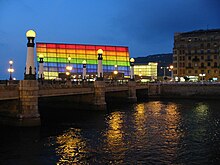
Victoria Eugenia Theatre at night


Port of San Sebastián in 1890

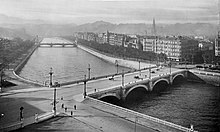
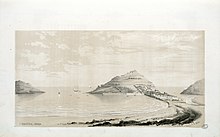

Donostia's Amara before river canalization in the mid 20th century

Ondarreta gardens, and former prison past the beach (far background)

Outlying rural areas were absorbed during the 1960s (Loiola)
Prehistory [edit]
The first bear witness of man stationary presence in the electric current city is the settlement of Ametzagaña, between Due south Intxaurrondo and Astigarraga. The unearthed remains, such as carved stone used every bit knives to cut animal pare, date from 24,000 to 22,000 BC. The open-air findings of the Upper Paleolithic have revealed that the settlers were modern human (Human sapiens) hunters, as well pointing to a much colder climate at the fourth dimension.[15]
Artifact [edit]
There were Roman settlements (from around 50-200 AD) in what is now the Old Function of the city, according to excavations carried out in the convent of Santa Teresa, on the slopes of Urgull.[sixteen]
San Sebastián is idea to accept been in the territory of the Varduli in Roman times. 10 km (half-dozen mi) e of the current city lay the Basque Roman town of Oiasso (Irun), which was for a long time wrongly identified with San Sebastián.
Center Ages [edit]
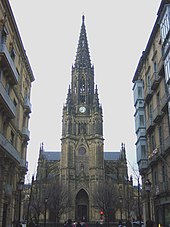
Afterwards a long period of silence in show, in 1014 the monastery of St. Sebastián with its apple orchards (for cider), located in the town of Hernani, was donated to the Abbey of Leire past Sancho III of Pamplona. By 1181, the city was chartered (given fuero) by king Sancho 6 of Pamplona on the site of Izurum, having jurisdiction over all the territory betwixt the rivers Oria and Bidasoa.
In 1200, the city was conquered by Castile, whose rex Alfonso VIII, confirmed its charter (fuero), but the Kingdom of Navarre was deprived of its chief direct access out to the sea. Possibly as soon equally 1204 (or earlier), the metropolis nucleus at the foot of Urgull started to be populated with Gascon-speaking colonizers from Bayonne and beyond, who left an important imprint in the city's identity in the centuries to come.[17]
In 1265, the use of the metropolis as a seaport was granted to Navarre every bit part of a nuptials pact. The big quantity of Gascons inhabiting the town favoured the development of trade with other European ports and Gascony. The city steered articulate of the destructive War of the Bands in Gipuzkoa, the only town in doing so in that territory. In fact, the town just joined Gipuzkoa in 1459 after the war came to an end.[17] Upward to the 16th century, Donostia remained mostly out of wars, but past the start of the 15th century, a line of walls of simple structure is attested encircling the town. The terminal chapter of the town in the Middle Ages was brought most by a fire that devastated Donostia in 1489. After burning to the ground, the town began a new renaissance by building up mainly with stone instead of bare timber.
Modernistic Age [edit]
The advent of the Mod Age brought a period of instability and state of war for the city. New state boundaries were drawn that left Donostia located close to Kingdom of spain'south border with French republic; thicker and more sophisticated walls were erected, with the town condign involved in the 1521–1524 military campaigns that formed role of the Castilian conquest of Navarre. The town provided critical naval help to Emperor Charles 5 during the siege of Hondarribia, which earned the boondocks the titles "Muy Noble y Muy Leal", recorded on its coat of arms. The town too aided the monarch by sending a party to the Battle of Noain and providing assistance to quash the Defection of the Comuneros in 1521.
After these events, Gascons, who had played a leading role in the political and economic life of the town since its foundation, began to be excluded from influential public positions by means of a string of regional sentences upheld by royal decision (regional diets of Zestoa 1527, Hondarribia 1557, Bergara 1558, Tolosa 1604 and Deba 1662).[17] Meanwhile, the climate of war and disease left the town in a poor condition that drove many fishermen and traders to accept to the sea every bit corsairs as a way of getting a living, most of the times under the auspices of the king Philip 2 of Spain, who benefited from the disruption caused to and wealth obtained from the French and Dutch trade ships.
In 1660, the city was used as the royal headquarters during the marriage of the Infanta to Louis XIV at Saint-Jean-de-Luz nearby. After a relatively peaceful 17th century, the boondocks was besieged and taken over by the troops of the French Duke of Berwick up to 1721. However, San Sebastián was not spared by shelling in the French attack and many urban structures were reconstructed, e.chiliad. a new opening in the heart of the town, the Plaza Berria (that was to become the current Konstituzio Plaza).
In 1728, the Guipuzcoan Company of Caracas was founded and boosted commerce with the Americas. Thanks to the profit the company generated, the boondocks underwent some urban reforms and improvements and the new Santa Maria Church was erected by subscription. This flow of wealth and development was to terminal upwardly to the terminate of 18th century.[eighteen] : 56/58
In 1808, Napoleonic forces captured San Sebastián in the Peninsular State of war. In 1813, after a siege of diverse weeks, on 28 August, during the night, a landing party from a British Royal Navy squadron captured Santa Clara Isle, in the bay. Situated on a narrow promontory that jutted out into the sea between the waters of the Bay of Biscay and the broad estuary of the Urumea River, the town was hard to go at and well fortified – "it was the strongest fortification I ever saw, Gibraltar excepted", wrote William Dent.[19] Three days subsequently, on 31 August, British and Portuguese troops besieging San Sebastián assaulted the town. The relieving troops ransacked and burnt the city to the basis. Only the street at the foot of the hill (now called 31 August Street) remained.
Contemporary history [edit]
Afterward these destructive events, reconstruction of the city was commenced in the original location with a slightly contradistinct layout. A modern octagonal layout as drafted by the architect P.M. Ugartemendia was turned downwardly and eventually Chiliad. Gogorza'due south blueprint was approved, then supervised and implemented by the Ugartemendia. This area, the one-time town, has a neoclassical, austere and systematic style of architectural construction. Constitution Foursquare was built in 1817 and the town hall (currently a library) between 1828 and 1832.[13] : 100 Housing in the old boondocks was built gradually alongside the rest of the area.
The liberal and bourgeois San Sebastián became the upper-case letter of Gipuzkoa (instead of Tolosa) until 1823, when absolutists besieged the town (only 200 inhabitants remained in the town when the offensive troops entered). It was designated again as the capital in 1854.[xx] In 1835-6, the British Auxiliary Legion under Sir George de Lacy Evans defended the town against the Carlist besiegers. Some of those who died were buried in the English Cemetery on Mount Urgull.
At the beginning of the 19th century, the local government was still ruled by the principle of dignity, while inhabitants of foreign origin or descent had ever been ubiquitous in the town, peculiarly amid the trading community. Although San Sebastián benefited greatly from the lease arrangement established in the Southern Basque Country (foruak, with borders in the Ebro river and no duties for overseas goods), the town was at odds with the more traditional Gipuzkoa, even requesting secession from the province and annexation to Navarre in 1841.
In 1863, the defensive walls of the town were demolished (their remains are visible in the underground motorcar park on the Boulevard) and an expansion of the town began in an attempt to move on from its previous military office.[21] Jose Goicoa and Ramon Cortazar were appointed to oversee the work. They modelled the new metropolis according to an orthogonal shape in a neoclassical Parisian style, and Goicoa designed several elegant buildings, such as the Miramar Palace and La Concha Promenade.[13] : 145–146 The city was chosen past the Castilian monarchy every bit a summertime retreat post-obit the French example of nearby Biarritz, and Spanish nobility and the diplomatic corps opened residences in the town. Every bit the "wave baths" at La Concha were in conflict with nearby shipbuilding action, the shipyards relocated to Pasaia, a nearby bay that had formerly been part of San Sebastián.
However, in 1875, war came to the town once more, and in 1876 shelling over the city by Carlists claimed the life of acclaimed the poet Bilintx.[xx] From 1885, King Alfonso XII of Espana's widow Maria Cristina spent every summertime in Donostia along with her retinue, staying at the Miramar Palace. In 1887, a casino was built, which eventually became the current metropolis hall, and some time after the Regional Authorities edifice was completed in Plaza Gipuzkoa following Jose Goicoa'southward design. Cultural life thrived in this menstruation, giving rise to various events that however have place in the metropolis, such as the Caldereros or the Tamborrada, and journalistic and literary works in both Castilian and Basque.
After much argue in the city over whether to pursue an economy based on tourism or manufacturing, Donostia developed into a fully-fledged seaside resort, but some manufacture adult in the commune of Antiguo and on the outskirts of the urban center. Following the outbreak of World State of war I, San Sebastián became a destination for renowned international figures of culture and politics,[twenty] including Mata Hari, Leon Trotsky, Maurice Ravel, and Romanones.
San Sebastián was one of earliest towns hitting by the 1918 Influenza epidemic, dealing with a first wave outbreak in February of that year. Officials feared for the city'due south reputation and attempted to keep the illness'southward spread tranquility, to no avail, and the outbreak soon spread throughout Spain.[22]
Various rationalist architectural works, typically white or light-coloured, were built in the 1920s and 1930s, such as La Equitativa, Nautico, and Easo. In 1924–1926, canalisation work was carried out on the Urumea river at the southern edge of the metropolis. However, afterward the city'due south Belle Epoque in the European wartime, repression under Miguel Primo de Rivera's dictatorship was not favourable for the city. In 1924, gambling was prohibited by the authoritarian government, causing existential problems for the Grand Casino and the Kursaal (1921).
In 1930, Spanish republican forces signed up to the Pact of San Sebastián, leading to the Second Castilian Commonwealth. Unrest and repression did not stop with the new political regime, and large-scale industrial activeness was chosen several times by the growing agitator, communist and socialist unions. The 1936 armed services coup was initially defeated by the resistance, led by the Basque Nationalists,[23] : 226 anarchists and communists, just afterwards that same yr the province fell to Castilian Nationalist forces during the Northern Campaign.[23] : 397 The occupation proved disastrous for the metropolis'due south residents. Between 1936 and 1943, 485 people were executed as a result of evidence trials by the Spanish Nationalists (Requetés and Falangists).[24] : 431 It has been estimated that extrajudicial executions (paseos) past the occupying military forces accounted for over 600 murders in the area during the first months of occupation.[24] : 431 Many children were evacuated to temporary safety in Bilbao, with the metropolis's population falling by an estimated 40,000 to 50,000 inhabitants.
In the aftermath of war, the city was stricken by poverty, famine and repression, coupled with a thriving smuggling trade. Many republican detainees were held at the beach-side Ondarreta Prison in grim and humid weather condition, until the edifice was demolished in 1948. However, industrial evolution paved the way for urban expansion in the Egia and Amara Berri districts, on the marshes and riverbed of the Urumea, at the end of the 1940s and beginning of the 1950s.
In 1943, the showtime Basque language schools were established by Elvira Zipitria, who taught in Basque from her home in the Sometime Boondocks. In 1947, the Grand Casino was converted into the City Hall.[13] : 95 In 1953, urban center businessmen organised the first San Sebastián International Flick Festival to stimulate the economic life and profile of the city.
Mass immigration from other parts of Espana, spurred by growing industrial product, greatly increased the population, initiating rapid and chaotic urban evolution on the outskirts of the metropolis (Altza, Intxaurrondo, Herrera, Bidebieta), yet social, cultural and political injustices followed, setting the scene for popular dissatisfaction. A full general climate of protest and street demonstrations followed, driven by Basque nationalists (especially the armed separatist organisation ETA) and various underground unions, triggering the get-go state of emergency in Gipuzkoa in 1968. Several more were imposed by the Francoist authorities in the period immediately preceding Franco'southward death in 1975.
Amidst the frail economical situation and real estate speculation, the Kursaal and the Chofre bullring in Gros were demolished in 1973.[20] From 1975 to 1977, sculptor Eduardo Chillida and architect Luis Peña Ganchegui's landmark The Rummage of the Winds was built at the western tip of the bay. The 1970s to the mid-1980s were years of general urban and social decay marked by social and political unrest and violence.
In 1979, the first autonomous municipal elections were held, won by the Basque Nationalist Political party, who held function along with splinter party Eusko Alkartasuna (Basque Solidarity) until 1991. The Spanish Socialist Workers' Political party's Odon Elorza took over as mayor from 1991 until 2011, when he was defeated unexpectedly by Juan Carlos Izagirre (Bildu) in elections.[twenty]
From the 1990s, a major makeover of the urban center centre began, aimed at enhancing and revamping the neoclassical and modernist side of San Sebastián'south architecture. Other regeneration projects included the reshaping and enlargement of Zurriola beach and promenade, the opening of the Kursaal Palace cubes (1999),[20] the new university campus and technology facilities in Ibaeta, the cosmos of a wide network of wheel lanes, underground automobile-parks and meaning improvements to public transport. Districts of cutting-edge design have been erected, such as Ibaeta and Riberas de Loiola, while some other major public works are still pending confirmation of funding and approval.
Districts of the metropolis [edit]

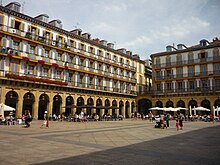
Façade of the Constitution Square (Plaza) in San Sebastián
As a outcome of San Sebastián's sprawling in all directions, first into the flatlands shaped by the river Urumea and later upward the hills, new districts arose after the walls of the city were demolished in 1863. The first expansion of the old town stretched out to the river's mouth, on the old quarter called Zurriola (a proper noun later given by Council conclusion to the sand area and the avenue across the river).[13] : 13, 322
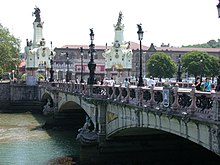
The orthogonal layout nowadays making upwardly the city heart (the Cortazar evolution) was built up to 1914 (first stage finished) much in tune with a Parisian Haussmannian style. The arcades of the Buen Pastor foursquare were fashioned afterwards the ones of the Rue de Rivoli, with the Maria Cristina Bridge being inspired by the Pont Alexandre Three that spans the Seine.[13] : 257 The Estación del Norte railroad train station continuing right across the bridge was inaugurated in 1864 only subsequently the arrival of the railway to San Sebastián, with its metal roof being designed by Gustave Eiffel. San Sebastián'southward central double-decker station is located hole-and-corner adjacent to the train station.[25]

Panoramic view of the La Concha Bay in the daytime

Panoramic view of La Concha Bay at night
Parte Vieja / Parte Zaharra [edit]
The Parte Vieja (Spanish) or Parte Zaharra[26] [27] (Basque) — Old Town – is the traditional core area of the city, and was surrounded by walls up to 1863, when they were demolished then as to occupy the stretch of sand and state that continued the town to the mainland (a stretch of the walls still limits the Old Office on its exit to the port through the Portaletas gate). The Old Town is divided in two parishes relating to the Santa Maria and San Vicente churches, the inhabitants belonging to the former known traditionally as joxemaritarrak, while those attached to the latter are referred to every bit koxkeroak. Until the early on 18th century, the koxkeroak mostly spoke Gascon. Especially after the cease of Franco'southward dictatorship, many confined were established around the Onetime Function. Most current buildings date back to the 19th century, built as part of the urban center's reconstruction after the 1813 destruction of the town by the allied Anglo-Portuguese troops.[eighteen] : 73–75, 81–89
There is a modest fishing and recreation port, with two-floor houses lined under the front-wall of the mount Urgull. Yet these houses are relatively new, resulting from the demilitarization of the hill,[13] : 218 sold to the city quango by the Ministry of War in 1924.


Antiguo [edit]
This part stands at the west side of the city across the Miramar Palace. Information technology is arguably the start population nucleus, even before the country at the foot of Urgull (Old Role) was settled. A monastery of San Sebastián el Antiguo ('the Old') is attested in documents at the time of the foundation (twelfth century).[xiii] : 35 At the mid 19th century, manufacture developed (Cervezas El León, Suchard, Lizarriturry),[28] the nucleus coming to be populated past workers. Industry has since been replaced past services and the tourist sector. The Matia kalea provides the main axis for the district.
Amara Zaharra [edit]
Or Old Amara, named after the farmhouse Amara.[13] : xxx It has somewhen merged with the urban center eye to a large extent, since quondam Amara lay on the marshes at the left of the River Urumea. The core of this district is the Easo plaza, with the railway terminal of Euskotren endmost the square at its southward.
Amara Berri [edit]
This city expansion to the south came about as of the 1940s, after the works to canalize the river were achieved.[13] : 30–31, 92 Nowadays the name Amara unremarkably applies to this sector, the newer district having overshadowed the original nucleus both in size and population. The district harbours the master route archway to the city. Facilities of many state run agencies were established here and presently Amara'southward buildings house many concern offices. The district revolves effectually the axis of Avenida Sancho el Sabio and Avenida de Madrid.
Gros [edit]
The district is built on the sandy terrain across the river. The Gros or Zurriola surf beach past the river's mouth bears witness to that type of soil. In the 19th century, shanties and workshops started to dot the surface area, Tomas Gros being one of its main proprietors besides every bit providing the proper name for this office of the city.[13] : 148–149 The expanse held the onetime monumental bullring Chofre demolished in 1973, on a site currently occupied by a housing estate. The commune shows a dynamic commercial activity, recently additional by the presence of the Kursaal Congress Eye by the beach.
Aiete [edit]
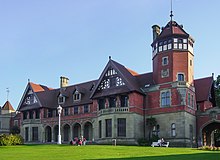
I of the newest parts in the city, it kept a rural air until not long ago.[13] : 60–61 The postwar city council bought the quaint chemical compound of the Aiete Palace for the utilize of Francisco Franco in 1940, correct subsequently the conclusion of the Civil State of war. The place in turn became the summer residence for the dictator up to 1975.[13] : 62 Present dwelling house to the Bakearen Etxea or Peace Memorial House.
Egia [edit]
Egia, stemming from (H)Egia (Basque for either bank/shore or hill), is a district of San Sebastián on the right side of the Urumea beyond the train station. At the beginning of the 20th century, a patch of land past the railway started to be used as a football pitch, eventually turning into the official stadium of the local squad Real Sociedad before it was transferred in the 1990s to Anoeta,[13] : 111 southward of Amara Berri (nowadays the site harbours houses). The former tobacco factory edifice Tabakalera, which has been converted into a Contemporary Culture Centre, conjures up the sometime industrial past of the area,.[13] : 111 Right contrary to this edifice lies the Cristina Enea park, a public compound with a botanic vocation. Egia holds the city cemetery, Polloe, at the n-east fringes of the district, stretching out to South Intxaurrondo.
Intxaurrondo [edit]
This function (meaning 'walnut tree' in Basque) is a large commune to the east of the metropolis. The original nucleus lies between the railway and the Ategorrieta Avenue, where even so today the farmhouse Intxaurrondo Zar, declared "National Monument", is situated since the mid-17th century. The railway cuts across the district, the southern side being the fruit of the heavy development undergone in the area during the immigration years of the 1950s and 1960s. In addition, further housing estates take been built up more than recently souther beyond the N-1 East-5 E-80 E-seventy band road (Southward Intxaurrondo). The police Guardia Civil runs controversial billet there (works for new housing are underway).
Altza [edit]
Altza (Basque for alder tree) is the easternmost commune of San Sebastián, along with Bidebieta and Trintxerpe. In 1910 it was a quaint village comprising scattered farmhouses and a modest nucleus, with 2,683 inhabitants, but the arrival of thousands of immigrants in the 1960s and 1970s led to rapid and chaotic housing and building action, resulting in a maze of grey mural of skyscrapers with a population of 32,531 in 1970. The population is 20,000 as of 2013[update].[29]
Ibaeta [edit]
Ibaeta stands on the former location for various factories (e.g., Cervezas El León) of San Sebastián, with the buildings of the old industrial estate existence demolished in the tardily 20th century. The levelling of this large flat area paved the basis for a carefully planned modernistic and elegant housing estate, featuring a new university campus for the public Academy of the Basque Country (UPV-EHU)[21] and institutions such equally the Donostia International Physics Center or the Nanotechnology Heart. A stream called Konporta flows down along the eastern side of the surface area, but it was canalized under the ground almost all along to its oral fissure on the bay pushed by urban building pressure.
Loiola [edit]
Information technology lies by the Urumea at the southward-e end of the city. It comprises a pocket-sized patch of detached houses (Ciudad Jardín) and a core area of 6-odd floor buildings. The district has recently gone through a major makeover, with works finishing in 2008. The road axis coming from of import industrial areas (Astigarraga-Hernani) crosses the district heading downtown. A military base stands beyond the river,[30] dwelling house to an insurgence in 1936. Attempts past the city quango to shut it have been unsuccessful and so far.
Riberas de Loiola [edit]
New modernistic district erected in the 2000s next to the metropolis's inner bypass and s road entrance to San Sebastián. A pedestrian bridge spans the Urumea river onto the Cristina Enea Park.
Martutene [edit]
The Martutene district bordering to the due south on the boondocks of Astigarraga comes next to Loiola in the south direction. This function of the urban center features an industrial area, a football pitch for lower leagues, a disused vocational training building and enclosure as well every bit a prison, much in decay and due to be transferred before long to a new location, probably in the municipality'southward exclave of Zubieta, while this option is coming in for much opposition.
Ulia [edit]

Onetime tank supplying the city with sanitary water in Ulia
This office stands on the due east side of the city at the foot of the Mount Ulia Park, on the left mitt side of the road heading from San Sebastián to Pasaia and Irun. It consists of a residential area, besides belongings a number of educational institutions, civilisation and sports centres built since 1980. The Park of Nurseries of Ulia sits at the base of the road leading to Mount Ulia, with its name deriving from its function as a nursery of plants for the public gardens of San Sebastián throughout the 20th century until 2008. It includes ii ancient water-tanks, architectonic elements, and specific flora and creature.
Añorga [edit]
Former area of caserios on the outskirts of San Sebastián, the institution in 1900 of the Cementos Rezola company in the neighborhood transformed Añorga into an industrial-type neighborhood, although it will lose its rural character that it once had. Even because Añorga a single neighborhood, iii distinct neighborhoods are generally distinguished: Añorga (Añorga Haundi), Añorga-Txiki and Rekalde. Co-ordinate to the National Found of Statistics, it had 1769 inhabitants in 2013.
Zubieta [edit]
The exclave Zubieta (meaning 'place of bridges') was a village until contempo years, with a number of houses, a pelota pitch (with a single wall as opposed to the regular ii) and a church. Still, it has since undergone much urban development, and is now a built-up area with paved streets and due equipment.[ citation needed ] There are two contested proposals for a new solid-waste matter incinerator and a prison house in the area. In the wake of the 1813 burning, inhabitants of San Sebastián held a meeting at a house in the village to decide the reconstruction of the town.
Culture and events [edit]

San Sebastián International Moving-picture show Festival, Ruby Carpeting
San Sebastián has a dynamic cultural scene, and was selected as European Capital of Civilization for 2016 (shared with Wrocław, Poland) with the motto, "Waves of people's energy".
Events ranging from traditional city festivals to music, theatre or cinema accept place throughout the year, especially in summer. In the last week of July, the city hosts the San Sebastian Jazz Festival (Jazzaldia), the longest continuously running Jazz Festival in Europe, featuring concerts staged in different locations around the city, sometimes with gratis admission. This is followed past the Musical Fortnight, which features classical music concerts taking place over 15 days into Baronial. The San Sebastián International Picture Festival is held in September, for more than 50 years, centred around the Kursaal Palace and the Victoria Eugenia Theatre. The city is also dwelling to the San Telmo Museoa, a major cultural institution with an ethnographic, creative and civic vocation.
Other cinema festivals in the urban center include: Street Zinema, an international audiovisual festival exploring gimmicky art and urban culture; the Horror and Fantasy Festival in Oct; and the Surfilm Festival, a cinema festival featuring surfing footage, specially shorts.
San Sebastián Day [edit]

Every year on twenty January, the feast of Saint Sebastian, the people of San Sebastián celebrate a festival known every bit the "Tamborrada", the most celebrated festival of the year for residents of the town. At midnight, in the Konstituzio plaza in the "Alde Zaharra/Parte Vieja" (Old Part), the mayor raises the flag of San Sebastián. For 24 hours, the unabridged urban center is filled with the sound of drums. The adults march around the city dressed as chefs and soldiers throughout the nighttime as part of the March of San Sebastián.[30]
On this day in the early on 19th century, a procession was held from the Santa Maria Church in the Old Role to the San Sebastián Church in the district of Antiguo, while later limited due to conditions weather condition to the walled area. The event finished with a public dance accompanied by the military band'south flutes and drums. Every day, a soldiers' parade took place to change the guards at the boondocks's southern walls. Since the San Sebastián Day was the first festival heralding the upcoming Carnival, exuberant youths began to follow them, aping their martial manners and drumrolls, using the buckets left at the fountains as drums.[18] : 107 The celebrations started to take their electric current form in the flow from the 1860s to 1880s, with real war machine style outfits and parades and music by composer Raimundo Sarriegui.[18] : 110
Adults commonly take dinner in txokos ("gourmet clubs"). Traditionally, these admitted only men, but now fifty-fifty the nigh conservative ones allow women on the "Noche de la Tamborrada". They eat sophisticated meals cooked by themselves, more often than not composed of seafood (traditionally elvers, at present no longer served due to its exorbitant cost) and drink the best wines.
La Semana Grande/Aste Nagusia [edit]

A festival, La Semana Grande in Spanish and Aste Nagusia in Basque ("The Large/Principal Week"), is held every year in mid-August. A major international fireworks competition is held during the festival, in which teams representing diverse countries and cities put on a fireworks display each night over the bay, with the winner of the contest announced at the end. The displays are sometimes accompanied by a total alive orchestra performing on the boardwalk. Attendees often claim spots along the beach and bay hours in advance.[30] The festival also includes a parade of marching bands, stilted entertainers, and large-heads costumes every afternoon.
Basque Week [edit]
This decades long festivity taking place at the showtime of September features events related to Basque civilization, such every bit performances of traditional improvising poets (bertsolaris), Basque pelota games, rock lifting contests, oxen wagers, dance exhibitions or the cider tasting festival. Yet the master highlight may be the rowing boat competition, where teams from different towns of the Bay of Biscay contend for the Flag of La Concha. Thousands of supporters coming from these littoral locations cascade into the city'south streets and promenades overlooking the bay to follow the consequence, specially on the Sunday of the final race. All 24-hour interval long the streets of the Onetime Role play host to droves of youths clad in their team colours who political party there in a cheerful atmosphere.
Santa Ageda Bezpera [edit]
Saint Agatha'southward Eve is a traditional event taking place at the beginning of February or end of Jan in many spots of the Basque Country. It holds a pocket-sized just cherished slot in the city's run-up to the Carnival. Groups dressed up in Basque traditional farmer costume march across the neighbourhood singing and wielding a characteristic stick browbeaten on the ground to the rhythm of the traditional Saint Agatha's tune.[30] The singers ask for a minor donation, which can be money, a drink or something to swallow.
Caldereros [edit]

This is a local festival held on the first Saturday of February linked to the upcoming Carnival, where different groups of people dressed in Romani (Gypsy) tinkers attire accept to the streets banging rhythmically a hammer or spoon confronting a pot or pan, and usually bar-hop while they sing the traditional songs for the occasion. They were just male voices some fourth dimension ago, but women participate and sing currently as well, and the main effect is at the Metropolis Hall, where the city band plays marches while the crowds bang the pots and pans. The festival began in 1884.[ citation needed ]
Santo Tomas [edit]
The Santo Tomas festival takes identify on Thomas the Campaigner's day, 21 December. From the early morning, stalls are erected around the metropolis centre, and visitors from beyond Gipuzkoa come to the centre and the Erstwhile Part, many dressed in traditional Basque "farmer" outfits. Traditional and typical produce is sold from the stalls; the master drink is cider and the nearly popular snacks are txistorra, a thin, uncured chorizo wrapped in talo flatbread. A big pig is displayed in Plaza Constitucion, which is raffled off during the festival.[30]
Olentzero [edit]
As in other Basque cities, towns and villages, on Christmas Eve the Olentzero and the accompanying carol singers unremarkably dressed in Basque farmer costume have over the streets, especially in the city centre, asking for small donations in bars, shops and banks afterwards singing their repertoire. Sometimes Olentzero choirs roam around the streets in later on dates, on the 31st for example, and are often related to cultural, social or political associations and demands.
Economy and industry [edit]
The main economical activities are commerce and tourism. San Sebastián is ane of the all-time-known tourist destinations in Spain.[8]
The international engineering science arrangement Ikusi is based in San Sebastián.
Send [edit]
The city is served by Euskotren Trena, Euskotren's railway network. Euskotren runs trains to Bilbao and other destinations, equally well as the San Sebastián Metro; which together with Renfe 'due south Cercanías San Sebastián cover the San Sebastián metropolitan area. In that location are frequent trains via San Sebastián railway station from Madrid to Hendaye in France, which is connected to the French rail network. The metropolis is also served by San Sebastián Airdrome in the nearby municipality of Hondarribia. San Sebastián Airport currently has no international destinations. Biarritz Airport in France is located almost 50 km from San Sebastián.
Gastronomy [edit]
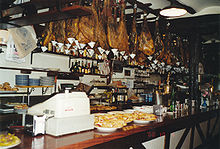

San Sebastián is renowned for its Basque cuisine. San Sebastián and its surrounding area is home to a loftier concentration of restaurants boasting Michelin stars including Arzak (San Sebastián), Berasategi (Lasarte), Akelarre (district Igeldo) and Mugaritz (Errenteria), to mention just a few.[31] It is the city with the second most Michelin stars per capita in the world,[32] simply backside Kyoto, Japan. Additionally, based on the 2013 ranking, 2 of the globe's peak ten best restaurants can be found here.[33] Adding to these cooking highlights, the urban center features tasty snacks similar to tapas called pintxos, which may exist establish at the bars of the Onetime Quarter.
It is as well the birthplace of Basque gastronomical societies, with the oldest recorded mention of such a txoko back in 1870. In add-on, it boasts the offset institution to offering a university degree in Gastronomy, the Basque Culinary Eye.[34]
University [edit]
Donostia-San Sebastián has become an important University town. Iv universities and a superior solarium are present in the city:
- Academy of the Basque State (UPV/EHU): San Sebastián hosts the Gipuzkoa Campus of the public academy.
- Academy of Navarra: The private university has an engineering-centered campus, Tecnun, in San Sebastián.
- Universidad de Deusto: Built in 1956, the San Sebastián campus of the individual academy offers dissimilar university degrees.
- Mondragon University: The pioneering Kinesthesia of Gastronomic Sciences of this individual university is located in San Sebastián.
- Musikene: The College School of Music of the Basque Country is located in San Sebastián.
The secondary studies action is having an increasing impact on social, cultural, technological and economical levels of the city and surroundings. With its pushing innovative and research centers and its enquiry strategies information technology is becoming one of Spain'south main Science production locations, along with Barcelona, Madrid, Bilbao, Seville and Valencia, among others. Donostia-San Sebastián'south scientific production covers areas like Materials Scientific discipline, Cancer Enquiry, Alzheimer and Parkinson, Compages, Polymer Science, Biomaterials, Nanotechnology, Robotics or Informatics.
Sport [edit]

Surf in Donostia-San Sebastián
The principal football club in the city is Real Sociedad. Later on three seasons in the Segunda División, the club won promotion dorsum to La Liga after winning the 2009–10 Segunda División.[35] Real Sociedad was 1 of the founding members of the top segmentation in Castilian football, La Liga. They enjoyed a especially successful catamenia of history in the early 1980s when they were Spanish champions for two years running (1980–81, 1981–82). In May 2019, Existent Sociedad'southward female team won the Queen's Loving cup for the first time.[36] The city's Anoeta Stadium located at the Anoeta Sports Circuitous is abode to the Real Sociedad and too hosts rugby matrimony matches featuring Biarritz Olympique or Aviron Bayonnais.
Each summertime the city plays host to a well known cycling race, the one-day Clásica de San Sebastián ("San Sebastián Classic"). Cycling races are popular in Kingdom of spain, and the Clásica de San Sebastián professional is held during early Baronial. It has been held annually in San Sebastián since 1981. The race is function of the UCI Earth Bout and was previously part of its predecessors UCI ProTour and UCI Road World Cup. A women's version of the race has been held since 2019.
Notable people [edit]

The comb of the wind: Peine del viento/Haizearen orrazia sculptures of Eduardo Chillida at the foot of the Igeldo mountain
- Mikel Arteta (1982–), Director and one-time footballer for Armory.
- Aritz Aduriz (1981–), footballer for Athletic Bilbao and winner of the 2015 Zarra Trophy as best domestic goalscorer in La Liga.
- Xabi Alonso (1981–), former professional footballer born in Tolosa but raised in San Sebastián. Part of the World Cup winning Castilian National Squad.
- José Luis Álvarez Enparantza "Txillardegi" (1929–2012), Basque linguist, politician and writer.
- Alicia Amatriain, ballet dancer
- Gretel Ammann (1947–2000), philosopher, essayist, activist, radical feminist, lesbian separatist.
- Luis Miguel Arconada Etxarri, (born 26 June 1954) is a former Real Sociedad and Spain'south team footballer, as goalkeeper.
- José de Arteche (1906–1971), author[37]
- Serafin Baroja (1840–1912), writer, Basque civilisation advocate and liberal. Male parent of Pio Baroja.
- Pío Baroja (1872–1956), author belonging to the Generation of '98.
- Carlos Bea, (born 18 April 1934), federal judge of the U.s.a. Courtroom of Appeals for the 9th Circuit
- Alvaro Bermejo (born 1 August 1959) author and announcer, author of best sellers like The Tibetan Gospel or The Labyrint of Atlantis.
- Indalezio Bizkarrondo "Bilintx" (1831–1876), a romantic poet and bertsolari closely attached to the city. Died later being hitting past Carlist shelling.
- Achille Broutin (1860–1918), fencer and collector of weapons.
- Emmanuel Broutin (1826–1883), fencer.
- Eduardo Chillida (1924–2002), sculptor, notable for his monumental abstract works.
- Arantza Díaz de Ilarraza Sánchez (1957), researcher in Language Engineering and Natural language processing for Basque and other languages.
- Catalina de Erauso (1585 or 1592–1650), former nun who travelled around Spain and the Americas as a man.
- Marina de Gabaráin (1917-1972), mezzo-soprano opera vocaliser
- Alberto Iglesias (1955–), music composer.
- Mikel Laboa (1934–2008), Basque vocalizer-songwriter.
- Ramon Lazkano (1968–), composer.
- Jesús María de Leizaola (1896–1989), President of the Basque Government in exile after 1960.
- Rebeca Linares (1983–), Spanish pornographic actress
- Sir Gilbert Mackereth (1892–1962), British World War I hero, holder of Military machine Cantankerous for gallantry. Retired to alive in San Sebastián and died there 1962, interred at San Sebastián.
- Iker Martínez de Lizarduy Lizarribar (1977–), Olympic crewman.
- Julio Medem (1958–), pic director.
- Alex Ubago (1981–), pop songwriter and vocaliser. Built-in in Vitoria just raised in San Sebastián.
- Juan Ugarte (1980–), onetime professional person footballer for Real Sociedad, Wrexham and Crewe Alexandra.
- Julio Urquijo Ibarra (1871–1950), Basque linguist.
- Fernando de Villanueva (died 1679), governor of Castilian New United mexican states between 1665 and 1668.
International relations [edit]
Twin towns – sister cities [edit]
As of 2021, San Sebastián is twinned with:
-
 Marugame, Kagawa Prefecture, Japan
 -
 Plymouth, Devon, England, United kingdom
 -
 Trento, Trentino-Alto Adige/Südtirol, Italy
 -
 Cape Bojador, disputed territory of Western Sahara
 -
 Reno, Nevada, U.s.a.
 -
 Wiesbaden, Hesse, Germany
Notes [edit]
- ^ The title of La bella Easo ("cute Easo") comes from a 19th-century identification of the town as the Roman port of Oiasso. Simply following the archaeological findings at the terminate of the 20th century, Irun, some 18 km (eleven mi) east, has been identified as the location of Oiasso.
- ^ "Eneko Goia, nuevo alcalde de San Sebastián". El Diario Vasco (in Castilian).
- ^ Municipal Annals of Spain 2018. National Statistics Institute.
- ^ Donostia (Basque) / San Sebastián (Spanish), El Diario Vasco, Thursday 29 December 2011. (in Spanish)
- ^ "Instituto Nacional de Estadística. (Spanish Statistical Establish)". world wide web.ine.es. Archived from the original on 29 November 2016. Retrieved 29 November 2016.
- ^ Proyecto Audes. Archived 22 August 2011 at the Wayback Machine
- ^ Donostiarra. Diccionario de la Real Academia Española.
- ^ a b "Geography and Economy of Donostia-San Sebastián". Retrieved three July 2011.
- ^ European Commission of Culture (28 June 2011). "Donostia-San Sebastián to be the European Capital letter of Culture in Spain in 2016". Retrieved 3 July 2011.
- ^ Trask, L. The History of Basque Routledge: 1997 ISBN 0-415-13116-2
- ^ (in Spanish) Koldo Mitxelena: Apellidos vascos, 1955, page 96.
- ^ (in Spanish) «Donostia-San Sebastián: Onomástica», Auñamendi Eusko Entziklopedia.
- ^ a b c d east f g h i j k l m n o Sada, Javier Maria; Sada, Asier (2007). San Sebastián: La Historia de la Ciudad a través de sus Calles, Plazas, Barrios, Montes y Caminos (third ed.). Andoain: Txertoa. p. 92. ISBN978-84-7148-399-7.
- ^ "VValores climatológicos normales. Hondarribia, Malkarroa". November 2015.
- ^ "Hallan un centenar de objetos de hace 22.000 años en el parque de Ametzagaina". El Diario Vasco. 23 March 2007. Article in Spanish
- ^ Unsain, J.One thousand. (2008): San Sebastián, ciudad marítima. San Sebastin: Museo Naval ISBN 978-84-930344-8-one, 164-7
- ^ a b c "LOS GASCONES EN GUIPÚZCOA" (in Spanish). IMPRENTA DE LA DIPUTACION DE GUIPUZCOA. Retrieved 17 September 2011.
- ^ a b c d Sadaba, Javier (1995). Historia de San Sebastián. San Sebastián: Editorial Txertoa. ISBN84-7148-318-1. Book in Spanish
- ^ 50. Woodford (ed.), A Young Surgeon in Wellingtons Ground forces: the Messages of William Dent (Onetime Woking, 1976), p. 39.
- ^ a b c d e f Berruso Barés, Pedro. "San Sebastián en los Siglos XIX y XX". Geografía east historia de Donostia-San Sebastián. Ingeba. Retrieved fifteen August 2013.
- ^ a b Gomez Piñeiro, Javier. "La Estructura Urbana". Geografía eastward historia de Donostia-San Sebastián. Ingeba. Retrieved 15 August 2013.
- ^ Gina Kolata (2000). Flu: The Story of the Nifty Influenza Pandemic of 1918 and the Search for the Virus That Acquired It. Farrar, Straus and Giroux. p. 9.
- ^ a b Hugh Thomas (2001). Spanish Civil War.
- ^ a b Paul Preston (2013). The Spanish Holocaust: Inquisition and Extermination in Twentieth-Century Spain. London, UK: HarperCollins. ISBN978-0-00-638695-7.
- ^ EiTB. "Inaugurada la nueva estación de autobuses de Donostia". world wide web.eitb.eus (in European Spanish). Retrieved x December 2016.
- ^ "Parte Zaharra", the Basque proper noun of the old town in the Basque-language page in the Donostia/San Sebastián Metropolis Council official website.
- ^ "Donostiako alderdi bati, ezagunetan ezagunena, Parte Zaharra deitzen genion guztiok, urtea joan eta urtea etorri, eta lasai bizi ginen, halaz ere. Orain berriz, Alde Zaharra bihurtu zaigu, mintzatzen ez den herriaren ondorioz [...]."
(Translation: "The virtually known role of San Sebastián was called by all of us Parte Zaharra, year after year, and we lived quietly, yet. Now, however, it has become Alde Zaharra, due to the people who do non speak [the Basque language].")
Koldo Mitxelena: «Atarikoak», in Ibon Sarasola (1997), Euskal Hiztegia, Kutxa, ISBN 8471733021. - ^ Segurola Lázaro, Carmen. "La Actividad Económica". GEOGRAFIA E HISTORIA DE DONOSTIA-SAN SEBASTIAN. Ingeba. Retrieved fifteen August 2013.
- ^ "Auzoak eta Herriak: Altza". Donostiako Udala – Ayuntamiento de San Sebastián . Retrieved 21 Baronial 2013.
- ^ a b c d eastward Saez Garcia, Juan Antonio. "La Tamborrada y otras Fiestas". Geografía e historia de Donostia-San Sebastián. Ingeba. Retrieved 15 August 2013.
- ^ "Donostia-San Sebastián Michelin restaurants". Via Michelin. 2013. Retrieved 12 Baronial 2013.
- ^ "The xx Most Michelin-Starred Cities in the World (PHOTOS)". The Huffington Postal service. sixteen August 2011.
- ^ "The Earth'southward 50 Best Restaurants (1–x)". The World's 50 All-time Restaurants. William Reed Business organisation Media Ltd. 2013. Archived from the original on 7 June 2013. Retrieved 12 August 2013.
- ^ "Habitation – Basque Culinary Centre". bculinary.com.
- ^ "Real Sociedad & Levante Promoted To Primera Liga". Goal.com. xiii June 2010. Retrieved 17 August 2012.
- ^ "A historic feat: Existent Sociedad wins the Copa de la Reina | tellerreport.com". www.tellerreport.com . Retrieved 12 May 2019.
- ^ José Arteche Aramburu, dbe.rah.es, accessed 21 August 2021
Bibliography [edit]
External links [edit]
- Official website
- Tourist information
- Official website of the campaigning to European Capital of Civilization 2016
- Images of San Sebastián in 1909
- San Sebastian Donostia Tourist Information
- Photos of San Sebastián
- Donostia photos
- "Donostia" group on Flickr
- DONOSTIA in the Bernardo Estornés Lasa – Auñamendi Encyclopedia (Euskomedia Fundazioa) (in Castilian)
- Tourism in the Basque Country
- University in San Sebastian
- Donostia Fairtrade Town Profile
Source: https://en.wikipedia.org/wiki/San_Sebasti%C3%A1n

Post a Comment for "Sebastian River Medical Center ~ a Steward Family Hospital Sebastian, Fl"